Why a 20-Minute Lunch Workout Beats a 5-Minute One (Even Though 5 Feels More Doable)
Quick Answer: A 20-minute session allows a proper warm-up, a real working set of exercises, and a brief cool-down — the structural pieces a 5-minute session has to skip entirely — which is why the return isn’t just 4x bigger, it’s disproportionately bigger.
5 minutes feels more realistic to commit to on a busy day, and that instinct isn’t wrong for some days. But when 20 minutes is genuinely available, the actual training return is disproportionately higher than the extra 15 minutes would suggest.

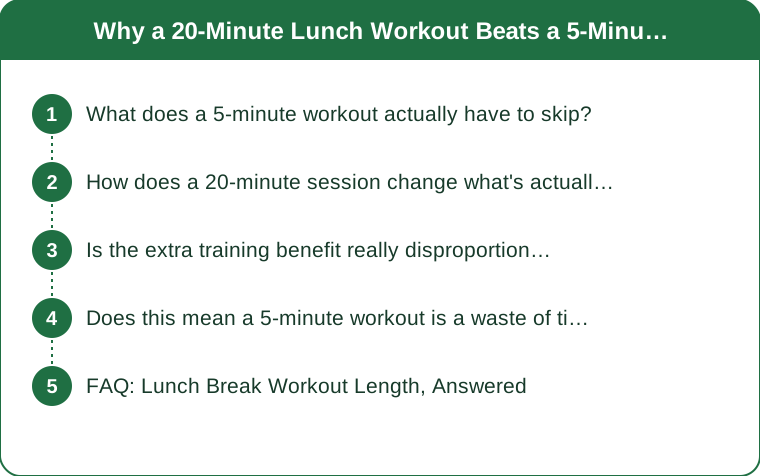
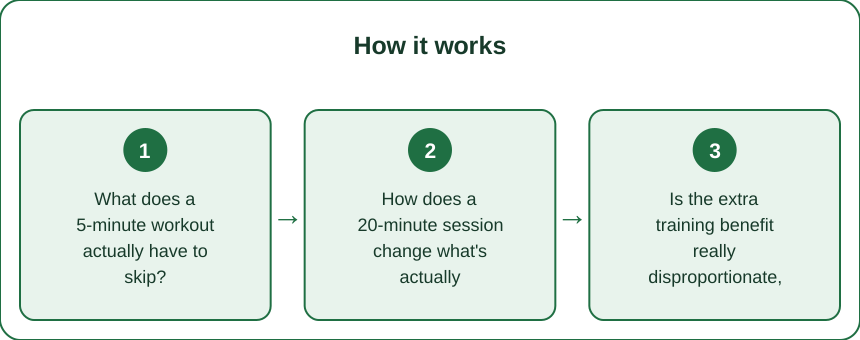
What does a 5-minute workout actually have to skip?
A 5-minute session has almost no room for a warm-up, meaning working sets start on cold muscles and joints — which limits both safe intensity and how much force you can actually produce. There’s also no room for a true cool-down or transition back to work mode, and typically only 1-2 exercises get real attention before time runs out.
How does a 20-minute session change what’s actually possible?
Twenty minutes allows roughly 2-3 minutes of warm-up, 12-15 minutes of real working sets across multiple exercises or muscle groups, and a short cool-down — a genuinely complete training structure. This isn’t just more volume; it’s the difference between a rushed, cold-start effort and a session with the physiological components that make training effective and safer.

Is the extra training benefit really disproportionate, or just proportional to the extra time?
Disproportionate, for a specific reason: a warm-up isn’t optional overhead, it’s what unlocks safer and higher force output during the working sets that follow. A 5-minute session without a warm-up produces lower-quality work per minute than a 20-minute session’s working sets do, on top of simply having more total minutes.
Does this mean a 5-minute workout is a waste of time?
No — a 5-minute session is still better than skipping the day entirely, and on a day when 20 minutes genuinely isn’t available, 5 minutes of movement has real value for circulation, mental reset, and habit consistency. The comparison here is about which to prioritize when you have a choice, not a case against short workouts existing at all.
FAQ: Lunch Break Workout Length, Answered
If I only have 10 minutes, is that closer to the 5-minute or 20-minute outcome?
Closer to the 20-minute outcome proportionally — even a short warm-up (60-90 seconds) followed by 7-8 minutes of focused work captures much of the disproportionate benefit a full warm-up unlocks.
Should I skip the warm-up to fit more working time into a short session?
Generally no — a brief, even 90-second warm-up improves the quality and safety of the working sets that follow enough to be worth the time trade, even in a tight window.
How do I decide between a 5-minute and 20-minute session on a given day?
If 20 minutes is genuinely available, prioritize it for the disproportionate training return — reserve 5-minute sessions for days when a longer window truly isn’t realistic, not as a default choice.
TL;DR:
- A 5-minute workout has no real room for a warm-up, limiting both safety and force output
- A 20-minute session allows warm-up, real working sets, and a cool-down — a complete structure
- The training benefit isn’t just proportional to time, it’s disproportionately higher
- A 5-minute session still beats skipping the day — this is about which to prioritize when you have a choice
When the time is available, 20 minutes earns its keep well beyond the extra 15 minutes it costs.
Keep Reading
This article is for general informational and styling purposes only. Fit, sizing, and product availability may vary.