Why Lunch Workouts Get Easier When the Weather Breaks
Quick Answer: A midday workout in August has to solve heat, sweat and recovery time on top of the workout itself. When the midday high drops from the high 80s into the low 70s, sweat production falls sharply, the no-shower problem largely disappears, and post-session cooldown drops from 20 minutes to about five. You are not more disciplined in September. The session costs less. Which means the version of the habit that failed in August is worth restarting rather than redesigning.
You committed to lunch workouts in July. You managed four of them. By mid-August you had stopped entirely and concluded you were not a lunch workout person.
You might just be a person who tried to start one during the worst six weeks of the year for it.

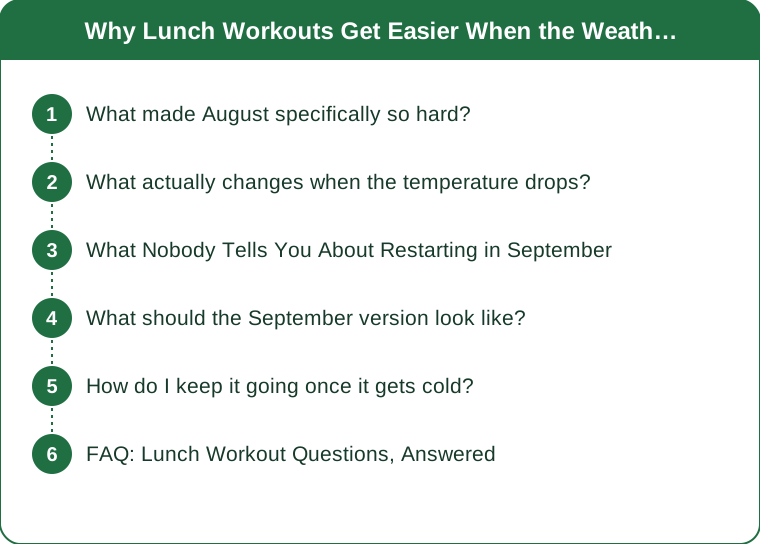
What made August specifically so hard?
The workout was never the expensive part. The logistics were.
Sweat volume. Exercising outdoors at 88F produces dramatically more sweat than the same effort at 72F, and evaporative cooling works poorly in humidity, so you keep sweating without cooling down.
Cooldown time. This is the killer. After a session in real heat, your core temperature stays elevated and you continue sweating for 15 to 25 minutes, which means the 30-minute break you allocated needs 50 minutes to actually complete. Not sweating through your afternoon shirt requires time you do not have.
Perceived effort. The same pace at the same fitness feels considerably harder in heat, so the session that was pleasant in May feels punishing in August.
Afternoon cost. Heat plus exertion plus a rushed lunch is a reliable recipe for a 3pm energy crash, and once that happens twice, your brain stops volunteering for it.
None of that is a motivation problem. It is a set of real constraints that mostly disappear with the weather.
What actually changes when the temperature drops?
The numbers move in your favour across the board.
Sweat drops sharply. A brisk 25-minute walk or an indoor circuit at 72F produces a fraction of the sweat that the same session produces at 88F, and much of it evaporates during the session rather than after.
Cooldown shortens to about five minutes. This is the single biggest change. It converts a 50-minute logistical problem back into a 30-minute break.
Perceived effort falls at the same pace, so you can do more meaningful work in the same time.
The afternoon crash largely resolves, because you are not spending the next two hours thermoregulating.
The result: the identical session that was borderline impossible becomes routine, without any change in your discipline, planning or fitness.
Which is worth knowing before you conclude anything about your character in late August.
What Nobody Tells You About Restarting in September
The first thing: restart the exact same plan, not a better one. People who failed in August tend to redesign the whole thing, adding accountability systems and new gear. The plan was fine. The environment was not. Redesigning adds friction to something that was already close to working.
The second: the first cool week is the highest-leverage week of the year for this habit. Motivation and conditions align exactly once, and habits started when conditions are favourable survive into worse conditions far better than the reverse. A lunch workout habit established in September is still running in November. One attempted in August rarely reaches September.
The third: your calendar changes in September too, and not in your favour. School restarts, meeting volume rises, and the empty midday slot you had in August gets contested. Book it before someone else does, in the first week, while the slot is still yours.
And the fourth, which catches people out: the no-shower calculation changes but does not vanish. A cool day still produces sweat during a hard session. The difference is that a moderate session becomes fully shower-optional, which is why September is the month to lock in the moderate version rather than the ambitious one.

What should the September version look like?
Build it around the constraint that actually binds: total elapsed time.
-
25 minutes of movement, 5 minutes of cooldown and change. That fits a genuine 30 to 40 minute break with the walking either side.
-
Moderate intensity, deliberately. Hard enough to matter, easy enough to skip the shower. This is the whole trade, and pushing intensity is what breaks the habit.
-
Outdoors while you can. The cool-weather window between roughly mid-September and early November is the best outdoor training weather of the year in most of the US. Use it before it goes.
-
Blocked in the calendar as a real appointment, with a name that does not invite a meeting request.
-
Clothes ready the night before. The friction point in a workday session is the decision, and the decision happens faster when the bag is packed.
-
A plan B of a 10-minute walk. A short walk on a bad day preserves the habit. A skipped day breaks the chain, and chains are what carry the habit into the weeks when the weather turns again.
How do I keep it going once it gets cold?
The habit built in September has to survive two more transitions, and both are predictable.
Late October: it gets dark and cold enough to need layers. The failure mode here is the extra two minutes of changing. Solve it by moving indoors or by keeping a dedicated layer at your desk rather than in your bag.
December: the slot gets eaten. Holidays, deadlines and shorter effective workdays. Solve it by shrinking rather than skipping. Fifteen minutes protects the habit through a bad month at almost no cost.
The general principle: a habit that has run for eight weeks survives a bad fortnight. A habit that has run for two weeks does not. Which is exactly why starting in the easy season is not cheating, it is strategy.
The people who train through February are almost never the people who started in February.
FAQ: Lunch Workout Questions, Answered
Is a lunch workout actually worth it if it is only 25 minutes?
Yes. Twenty-five minutes of moderate activity most weekdays comfortably exceeds general activity guidelines, and the consistency is worth more than the duration.
Should I eat before or after?
A small amount before, a proper meal after. A full lunch immediately before a session usually makes the session unpleasant, and skipping food entirely makes the afternoon worse.
What if my workplace has no shower?
Design for it rather than around it. Moderate intensity, a dry shirt to change into, and a quick wipe down handles the vast majority of cool-weather sessions.
Will I be less productive in the afternoon?
Generally the opposite for a moderate session, though a hard session in heat reliably produces the crash people fear. Intensity, not exercise, is the variable.
This is general information, not medical advice.
TL;DR:
- August lunch workouts fail on sweat volume and cooldown time, not motivation.
- Cooler weather cuts cooldown from 20 minutes to about five, which is what makes the break work.
- Restart the same plan, do not redesign it, and book the slot in the first cool week.
- Keep it moderate and shower-optional, with a 10-minute walk as plan B.
If you tried this in August and stopped, you got an honest result from a rigged test. Run it again in the next few weeks, while the conditions are on your side, and see what the habit actually looks like.
Keep Reading
This article is for general informational and styling purposes only. Fit, sizing, and product availability may vary.