Is a 20-Minute Lunch Break Workout Actually Worth It?
Quick Answer: Yes — 20-minute workouts, done consistently, produce meaningful cardiovascular and strength benefits, and several studies show they can match longer sessions on key markers when intensity is kept high. The bigger factor is consistency, not session length.
Twenty minutes feels like it shouldn’t count for much next to an hour-long gym session. But the research on shorter, focused workouts tells a more encouraging story than the ‘more is better’ assumption suggests.

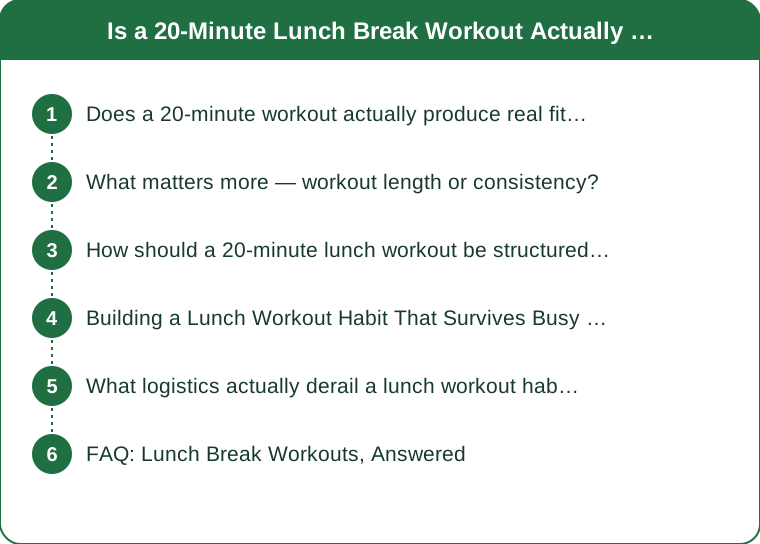
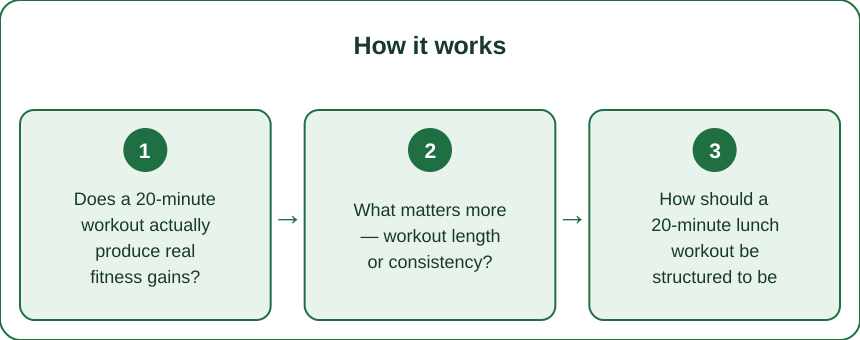
Does a 20-minute workout actually produce real fitness gains?
Yes, when intensity is managed well. Multiple studies on short, structured workouts (15-25 minutes) show meaningful improvements in cardiovascular fitness and strength, provided the time is used efficiently — supersets, minimal rest, and compound movements rather than long rest periods between isolated exercises. The workout doesn’t need to be long to be effective; it needs to be dense.
What matters more — workout length or consistency?
Consistency, by a wide margin in the research. A 20-minute workout done 4-5 times a week consistently outperforms a 60-minute workout done sporadically once every week or two for nearly every fitness outcome tracked in longitudinal studies. The lunch break format’s biggest advantage isn’t the workout itself — it’s that a 20-minute time block is dramatically easier to protect on a busy calendar than a 60-minute one.
How should a 20-minute lunch workout be structured to be effective?
Compound movements, minimal rest, and a built-in warm-up buffer. A reasonable structure: 3-4 minutes warm-up, 12-14 minutes of circuit-style strength or interval work with 30-45 second rest periods, 2-3 minutes cool-down. This maximizes actual working time within the available window rather than losing minutes to long rest periods or equipment setup.

Building a Lunch Workout Habit That Survives Busy Weeks
The habit that survives isn’t the ambitious version — it’s the one with a built-in fallback. Plan a full 20-minute version and a 10-minute backup version for the days that get eaten by meetings. Doing the 10-minute backup consistently beats skipping entirely on a day the full version doesn’t fit, and it protects the habit loop for the following day.
What logistics actually derail a lunch workout habit?
Clothes and cleanup, more often than the workout itself. Keeping a small kit at your desk or car (a change of top, dry shampoo or wipes, deodorant) removes the most common friction point — needing to go home first, which usually means the workout just doesn’t happen. Logistics prep, not motivation, is the actual bottleneck for most people trying to build this habit.
FAQ: Lunch Break Workouts, Answered
Can you build muscle with only 20-minute workouts?
Yes, especially with progressive overload on compound lifts — muscle growth responds more to total weekly volume and consistency than to any single session’s length.
Is it better to do cardio or strength training in a short lunch window?
Strength training with some interval elements built in tends to give more bang for the time, since it builds both muscle and elevates heart rate simultaneously.
Will a 20-minute workout leave you too tired for the rest of the workday?
Most people report the opposite after the first couple weeks of adjustment — a midday movement break tends to improve afternoon focus and energy rather than draining it.
TL;DR:
- 20-minute workouts produce real fitness gains when intensity is managed well
- Consistency matters more than session length for long-term results
- Structure: short warm-up, dense circuit work, short cool-down
- Keep a 10-minute backup plan and a desk kit to protect the habit on busy days
Twenty minutes isn’t a compromise — for most people’s actual weekly schedule, it’s the format most likely to still be happening in six months.
Keep Reading
This article is for general informational and styling purposes only. Fit, sizing, and product availability may vary.