How to Stop Other People From Eating Your Lunch Workout
Quick Answer: A lunch workout dies for structural reasons, not motivational ones. An unblocked midday slot is the most bookable time in anyone’s calendar, and once it is taken twice, the habit stops being a default and becomes a decision you have to make every day. Decisions lose to defaults, reliably.
The defence is three things: a recurring calendar block with a real name, a fixed backup slot, and a minimum version that survives a shortened window.
None of it requires telling anyone what you are doing.

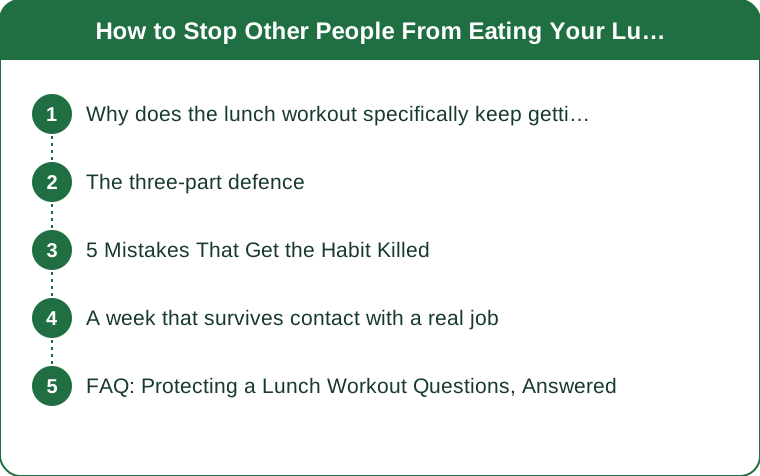
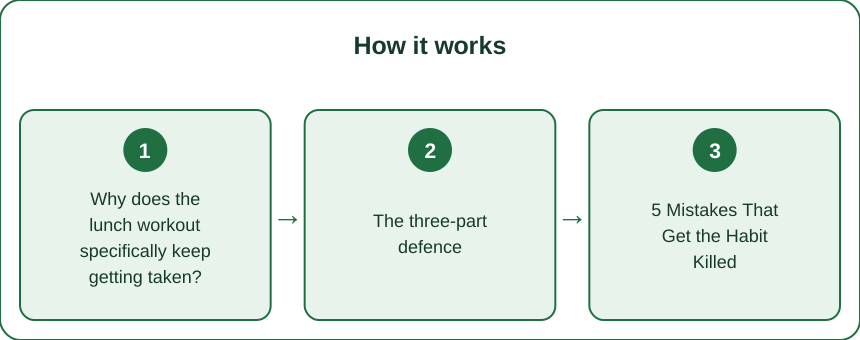
Why does the lunch workout specifically keep getting taken?
Because of where it sits in the day, not because of how much you want it.
Midday is the highest-demand slot in any calendar. It is the middle of the overlap between time zones, after the morning has filled up, and before the end-of-day rush. Scheduling tools will suggest it first for exactly these reasons.
An unmarked block reads as available. Calendar software treats empty time as free time, and so do colleagues. An unblocked lunch hour is not protected in any sense - it is simply the next slot the system will offer someone.
Once it goes twice, the default breaks. Habits run on defaults, and a default survives being interrupted occasionally and not being interrupted regularly. After two or three overrides, you are making a fresh decision every day, and daily decisions have a poor success rate under work pressure.
The window is genuinely tight. A 60-minute lunch minus changing, travel, and getting back to your desk leaves perhaps 25 usable minutes. Lose ten to a meeting that overran and the whole thing becomes not worth starting - which is the moment most people quietly abandon it.
And there is a social cost people overestimate. Declining a midday meeting feels harder than declining a 4pm one, so people accept things at lunch they would push back on at any other hour. This is worth naming, because it is the actual barrier for most people rather than any of the logistics.
The three-part defence
1. A recurring calendar block with a real name. Put it in the calendar as a recurring appointment, marked busy, with a name that reads as a commitment - not “gym”, not “blocked”. Something like “Personal appointment” or “Focus block”. The name matters because a block that reads as optional gets treated as optional, both by others and by you.
Two practical details: make it 15 minutes longer than you need on each side, so an overrunning previous meeting does not eat into the workout itself. And make it recurring rather than added weekly - a weekly addition is a weekly decision.
2. A fixed backup slot. Decide in advance where the workout goes when the block genuinely has to move - typically 4pm, or the following morning. The value is in deciding once, so that when it happens you are executing rather than negotiating. Without a designated backup, a moved workout becomes a cancelled workout every time.
3. A minimum version. Define a 12-minute version of your session in advance. When you get 25 minutes instead of 45, you run the short version rather than skipping. The habit survives on the short days, and short days are most days.
Why all three are needed. The block stops most incursions. The backup handles the ones it cannot stop. The minimum version handles the compressed days. Any one alone fails within a month, because each addresses a different failure mode.

5 Mistakes That Get the Habit Killed
1. Leaving the slot unblocked because you ‘know’ it is your time. Your calendar does not know that, and neither does anyone booking into it. This is the single most common failure and the easiest to fix.
2. Blocking it as tentative or free. A tentative block still shows as bookable in most systems. It has to be marked busy to do anything at all.
3. Making it too long. A 90-minute block will get challenged and eventually overridden. A 45-minute block that is genuinely protected beats a 90-minute one that is theoretical - and the shorter block is far easier to defend.
4. No backup plan. A workout that gets moved without a designated destination gets deleted. Decide the backup once, in advance, when you are calm and not looking at a calendar conflict.
5. Explaining yourself. “I have a commitment then” is a complete sentence. People who explain that it is a workout invite negotiation about whether a workout is as important as a meeting, which is a conversation with no upside. Nobody asks what the dentist appointment is for.
The fifth one is where most people lose ground, and it is entirely avoidable.
A week that survives contact with a real job
The goal is not a perfect week. It is a week where three sessions happen regardless of what the calendar does.
The structure:
- Block three days, not five. Three protected slots that hold beat five that get eroded, and three sessions a week is a genuinely effective training frequency
- Pick your least meeting-heavy days. Look at the last month and choose accordingly - this is five minutes of analysis that saves months of friction
- Non-consecutive, so a bad day has a natural recovery slot
- Same time every week, because variable timing is another daily decision
Each session, three versions defined in advance:
- Full, 40 minutes - the intended session
- Compressed, 20 minutes - the main work only, no accessories
- Minimum, 12 minutes - one hard block, or a brisk walk. The minimum version is what keeps the streak alive and it counts
Logistics that remove the remaining friction:
- Bag packed the night before, kept at the desk or in the car - not at home
- No-shower sessions on the tightest days. Lower intensity, a change of top, and dry shampoo covers more situations than people admit
- Eat afterward, not before. A workout at 12:30 and lunch at 13:15 works better than the reverse and removes the digestion problem entirely
And what to do when it collapses anyway, which it will during a bad month: restart with the minimum version only, three days a week, for two weeks. Rebuilding the default matters more than the content of the sessions, and the content can return once the slot is holding again.
FAQ: Protecting a Lunch Workout Questions, Answered
Should I tell my manager what the block is for?
Only if it helps you - many workplaces are supportive and some make it awkward. “A standing personal commitment” is accurate, sufficient, and does not invite a discussion about relative priorities.
What if my job genuinely cannot protect a midday hour?
Then the lunch workout is the wrong slot for you, and the honest move is to relocate rather than keep failing at it. Before work or immediately after work are the two alternatives with the best adherence data, and either beats a lunch habit that breaks weekly.
Is a 20-minute workout actually worth doing?
Substantially, yes - twenty focused minutes three times a week is a real training stimulus and vastly better than the 45-minute sessions you did not do. The comparison that matters is against zero, not against an ideal session.
How do I handle a colleague who books over it repeatedly?
Decline and offer two alternative times in the same reply, which resolves it without a conversation about why. If it keeps happening from the same person, a single direct “I’m not available at that time on those days” settles it permanently.
TL;DR:
- The lunch slot is the most bookable time in any calendar, and unblocked reads as free
- Block it as recurring and busy, with a name that reads as a commitment - not “gym”
- Decide the backup slot in advance, or a moved workout becomes a cancelled one
- Define a 12-minute minimum version so compressed days still count
- Protect three days rather than five, and never explain what the block is for
Open your calendar and put a recurring busy block on your three lightest days this week. That single action does more than any amount of resolve.
Keep Reading
This article is for general informational and styling purposes only. Fit, sizing, and product availability may vary.