The Desk Drawer Gym: A Resistance Band Under Your Keyboard
Quick Answer: One long loop band and one mini band fit in a desk drawer and cover a full five-minute strength break — band pull-aparts, seated rows, mini-band leg press-outs, overhead presses, and calf raises. No changing clothes, no sweating. Do it twice a day, anchored to coffee runs or the end of meetings.
Your desk drawer contains pens, three dead cables, and a charger for something you no longer own.
In the drawers of the quietly fit, it also contains a resistance band — which is, functionally, an entire gym that fits under a keyboard.
Five minutes. No clothes change. And it targets exactly the muscles a desk spends eight hours dismantling.

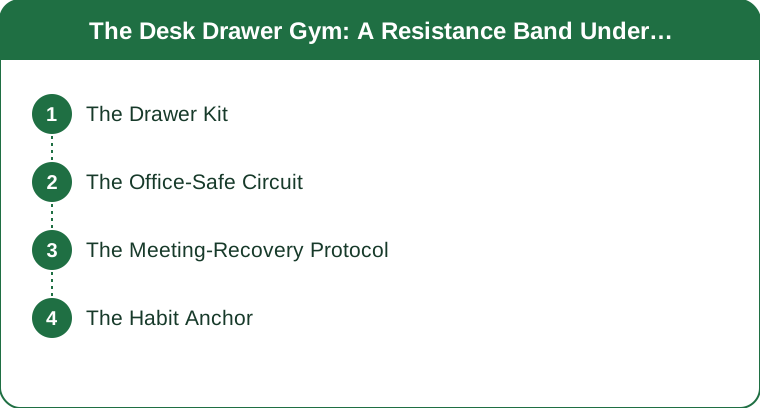
What do I actually need in the drawer?
Two bands. That’s the whole inventory.
One long loop band (light to medium resistance) for rows, pull-aparts, and presses. One mini band for hips and glutes. Total drawer space: about the footprint of a sandwich. Total cost: usually under $20 for both.
That’s it. No handles, no anchors, no door attachments — all of which need setup you won’t do at 3 p.m. in an open office.
What this replaces: not a full gym, but the posture-corrective half of one — the rows, pulls, and hip work that counteract sitting. Which happens to be exactly the half that desks destroy and that most people skip at the gym anyway.
Band resistance also happens to suit the office context well. It’s quiet, it packs flat, and unlike dumbbells it doesn’t announce itself when you drop it.
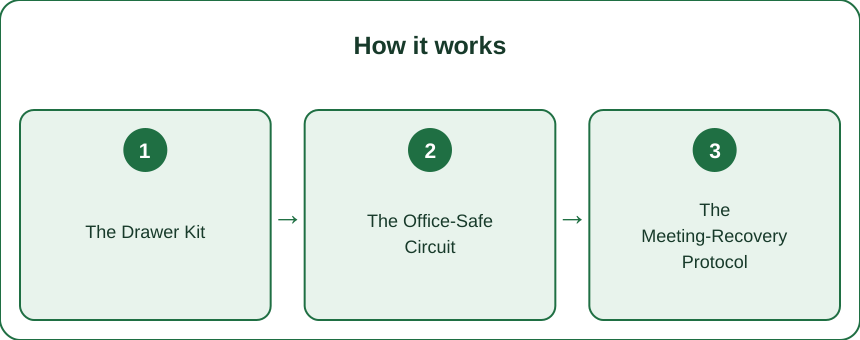
What’s the office-safe circuit?
Five minutes, business attire compatible, no sweat threshold crossed.
1. Band pull-aparts — 15 reps. Hold the long band at shoulder width in front of you, arms straight, and pull outward until the band touches your chest. Squeeze the shoulder blades. This is the single highest-value desk exercise there is — it directly reverses the rounded-forward shoulder position.
2. Seated band rows — 12 reps. Loop the band around a desk leg or table support, sit back, and row toward your ribs with elbows close. The anti-hunch movement.
3. Seated mini-band leg press-outs — 15 reps. Mini band above the knees, feet flat, press the knees outward and hold two seconds. Wakes up glutes that have been dormant since 9 a.m.
4. Standing overhead press — 12 reps. Stand on the middle of the long band, press overhead. Skip this one if your office culture makes it feel conspicuous; it’s the most optional item on the list.
5. Desk-edge calf raises — 20 reps. Hands on the desk for balance, rise onto the toes, lower slowly. Also nudges circulation in legs that have been still for hours.
Total: about five minutes at a controlled pace. Do them in order, one round. Two rounds if you have ten minutes and the meeting got cancelled.
Form note that matters more than any of the above: move slowly on the way back. The lowering phase is where the actual strength work happens, and it’s the part everyone rushes.

Can a band break help after a bad meeting?
That’s arguably its best use, and it’s not really about strength.
Stress lives physically in the shoulders and jaw. After a difficult call, most people are holding a genuine muscular clench they haven’t noticed. Sitting straight through into the next meeting carries that tension forward, and it compounds across a day.
The two-minute protocol: 15 band pull-aparts, done slowly, paired with long exhales — inhale for 4 seconds, exhale for 6. Then 10 seated rows.
The mechanism is simple: the pull-aparts move the exact muscles doing the clenching, and the extended exhale nudges the parasympathetic nervous system, which is the one responsible for standing down. Movement plus a longer exhale is a reliable combination for shifting out of a stress state.
Two minutes between calendar blocks is the buffer that stops meetings from bleeding into each other. It’s also a considerably better use of the gap than checking email you’ll re-check in nine minutes.
How do I make it an actual habit?
Attach it to something that already happens. Never rely on remembering.
Habit anchors that work in an office:
- Every second coffee refill. You’re already standing up.
- The end of every meeting. The transition already exists; you’re just filling it.
- The 3 p.m. slump slot. The band beats the vending machine on energy, at zero calories.
- Before lunch, as a hard stop that also gets you out of the chair.
Twice daily, five minutes each = 50 minutes a week of posture-corrective strength work. That’s more targeted upper-back and hip work than most people do at the gym, achieved entirely inside a normal workday.
The reason this survives busy season — and almost nothing else does — is that it lives inside the workday rather than competing with it. A 6 a.m. gym plan dies in week three of a hard quarter. A band in a drawer doesn’t require the quarter to cooperate.
Keep the band visible. In the drawer is fine; buried under a folder is not.
5 Mistakes Everyone Makes With Desk Band Workouts
- Buying a band that’s too heavy. Light resistance with 15 controlled reps beats heavy resistance with 6 sloppy ones, and heavy bands make you sweat, which defeats the purpose.
- Anchoring to something that moves. An office chair leg will roll. Use a fixed desk leg or a table support.
- Rushing the return. The lowering phase does most of the work. Three seconds back, every time.
- Doing it “when there’s time.” There is never time. Anchor it to coffee or meeting ends or it won’t happen.
- Leaving the band at home after taking it out to clean. The one that actually kills the habit — the whole system depends on the band living permanently in the drawer.
FAQ
Can you really build strength with resistance bands at a desk?
You can build meaningful strength in the upper back, rear shoulders, and hips — the muscles that respond well to high-rep, moderate-resistance work and that sitting weakens most. You won’t build significant size or lower-body max strength this way. As a supplement to real training, or as a counterweight for a sedentary job, it’s genuinely effective.
How often should I do desk exercises?
Twice a day is a good target, five minutes each. More important than the count is breaking up long sitting blocks — standing and moving every 30–60 minutes is associated with better outcomes independent of any structured exercise you do.
Will this fix my posture?
It helps meaningfully, but posture is a combination of strength, habit, and workstation setup. Bands address the strength piece — particularly the weak upper back that lets shoulders round forward. Also check your monitor height (top of the screen at eye level) and chair position. If you have persistent neck or back pain, numbness, or tingling, see a physical therapist or physician rather than working around it.
What should I wear if I want to do this comfortably?
Whatever you’re already in — that’s the design constraint. All five exercises work in normal business clothes. If your office leans casual, stretch trousers or a high waist yoga pant in a matte ponte makes the seated hip work noticeably easier and still reads as office-appropriate.
TL;DR:
- Two bands — one long loop, one mini. Sandwich-sized, under $20
- The five-move circuit: pull-aparts, seated rows, leg press-outs, overhead press, calf raises
- Pull-aparts are the highest-value move — they directly reverse desk shoulders
- Move slowly on the return; that’s where the strength happens
- Post-meeting protocol: 15 pull-aparts plus 4-second-in, 6-second-out breathing
- Anchor to coffee refills and meeting ends — twice daily is 50 minutes a week
The desk was doing daily damage on schedule. The drawer now does daily repair on the same one.
Keep Reading
This article is for general informational and styling purposes only. Fit, sizing, and product availability may vary.