Building a Lunch Workout Habit That Survives Actually Busy Weeks
Quick Answer: A lunch workout habit survives busy weeks when it has a built-in minimum version (5-10 minutes) instead of an all-or-nothing 30-minute standard. Habits that only have one full-length option collapse the first time a meeting runs long.
The lunch workout habit that felt solid for three weeks disappears the moment a genuinely packed week hits. That’s not a motivation failure — it’s usually a design flaw in the habit itself.

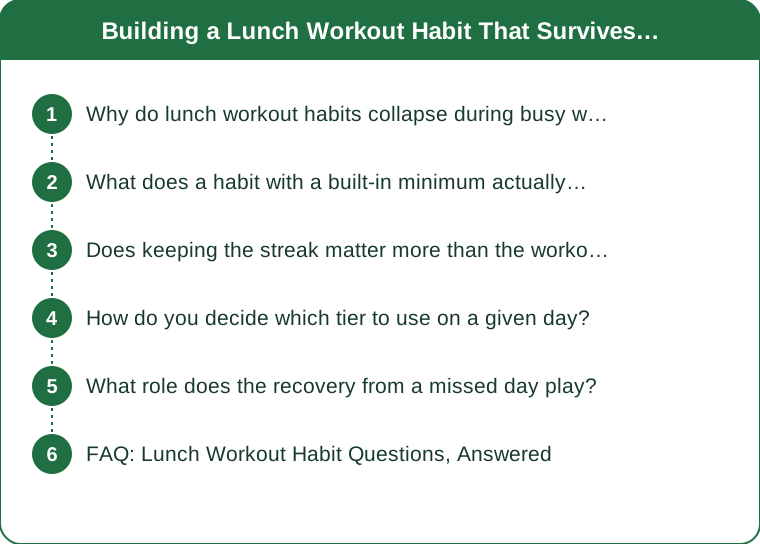
Why do lunch workout habits collapse during busy weeks specifically?
Most people build the habit around a single fixed version — a 30-minute session or nothing. When a busy day makes the full version impossible, ‘nothing’ becomes the only available option, and skipping once makes skipping again the following day much more likely.
What does a habit with a built-in minimum actually look like?
Define three tiers in advance: a full session (25-30 minutes), a moderate version (10-15 minutes), and a minimum version (5 minutes — even just a short walk or a few resistance band sets). On a genuinely packed day, doing the 5-minute minimum keeps the habit and identity intact, rather than breaking the streak entirely.
Does keeping the streak matter more than the workout itself in busy weeks?
During high-stress weeks specifically, yes — habit consistency matters more than any single session’s intensity. A short, easy session that keeps the pattern alive is more valuable long-term than an all-or-nothing standard that gets abandoned the first hard week and takes real effort to restart.

How do you decide which tier to use on a given day?
Check your calendar the morning of, not at lunch — decide the tier for the day in advance, the same way you’d pre-decide the workout itself. This removes the in-the-moment decision that often defaults to skipping when the day feels overloaded.
What role does the recovery from a missed day play?
One missed day handled well (returning the very next day, even at the minimum tier) has little long-term impact. Two or more consecutive misses are what actually predict habit abandonment in behavior research — so the priority after any miss is simply showing up again, even briefly, not making up for lost time.
FAQ: Lunch Workout Habit Questions, Answered
What’s a good 5-minute minimum-tier workout?
A brisk walk around the building, or a short resistance band circuit (squats, rows, presses) at your desk — the goal is keeping the habit alive, not maximizing effort.
Should I feel guilty about only doing the minimum tier some days?
No — the minimum tier existing and being used as intended is what makes the whole system sustainable through real busy weeks.
How long does it take before a lunch workout habit feels automatic?
Most habit-formation research suggests somewhere in the range of several weeks of consistent repetition, though having a flexible tiered system tends to shorten the effective timeline by reducing total missed days.
TL;DR:
- All-or-nothing habits collapse the first genuinely busy week — build in a minimum tier instead
- Define full, moderate, and 5-minute minimum versions in advance
- Consistency matters more than intensity during high-stress weeks specifically
- One missed day is fine; two in a row is the real habit-abandonment risk — just show up again
Set your three tiers tonight, then use whichever one actually fits tomorrow’s real schedule.
Keep Reading
This article is for general informational and styling purposes only. Fit, sizing, and product availability may vary.